Dobsonian vs Equatorial Mount: Which Should You Choose?
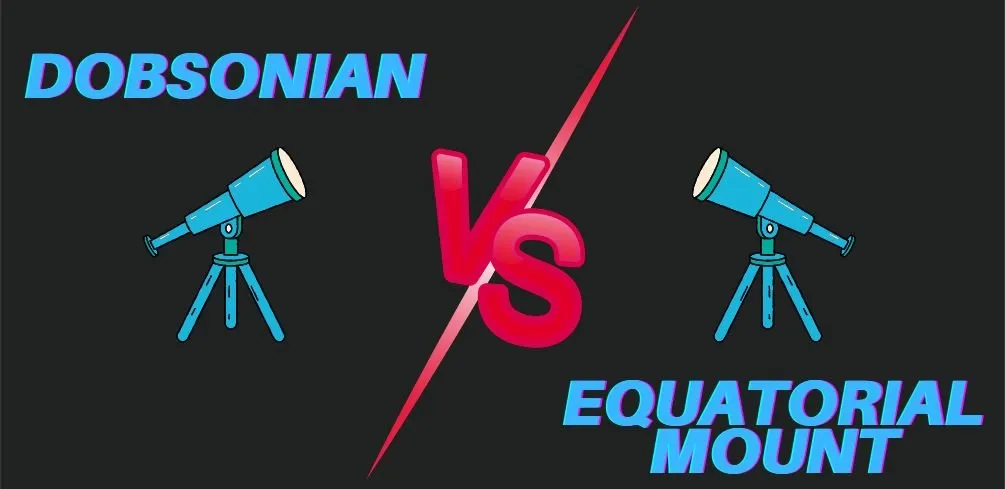
A Dobsonian mount is a simple up-down, left-right base that sits on the ground. It sets up in minutes and puts your money into aperture, so it's the better choice for looking. An equatorial mount tilts one axis to match the Earth's spin, so once it's polar aligned it follows the sky by turning one axis. That makes it the better choice for long-exposure photography, at the cost of weight and setup time.
On this page
If you mainly want to look at the Moon, planets and deep-sky objects, a Dobsonian gives you more telescope for the same money. If you want to take long-exposure photos, you need tracking, and an equatorial mount is the usual way to get it.
Side by Side
| Dobsonian | Equatorial | |
|---|---|---|
| How it moves | Up-down and left-right (a type of alt-azimuth) | One axis tilted to the celestial pole, one at right angles |
| Setup | Set the base down, place the tube, observe | Level the tripod, balance, rough polar alignment |
| Following objects | Nudge by hand every minute or so at high power | Turn one slow-motion knob, or let a motor do it |
| Typical telescope | 6- to 12-inch reflector | Refractor, small reflector or Schmidt-Cassegrain |
| Long-exposure photos | No (unless a tracking platform is added) | Yes, with a motor drive and good alignment |
| Aperture for the money | High | Lower: much of the budget goes into the mount |
| Learning curve | Point and look | Takes a few nights to feel natural |
How a Dobsonian Works
A Dobsonian is a Newtonian reflector on a low wooden or metal rocker box. The tube swings up and down on side bearings and the box turns on a flat base. John Dobson popularized the design in the 1960s and 70s as a way to build large telescopes cheaply, and it is still the most aperture per dollar you can buy.
Because it sits on the ground, it's steady: tap the tube and the view settles quickly. The catch is that the sky drifts. At 150x an object crosses the field in well under a minute, so you nudge the tube to keep up. Wide-field eyepieces help, because the object stays in view longer. GoTo and push-to Dobsonians exist, but they cost more.
The other limit is bulk. An 8-inch tube is about 4 feet long and the whole scope weighs around 40 to 50 pounds, moved in two pieces. See what you can see with an 8-inch Dobsonian for what that aperture shows.
How an Equatorial Mount Works
An equatorial mount tilts its main axis (right ascension) to point at the celestial pole, near Polaris in the Northern Hemisphere. The second axis (declination) sits at right angles. Once aligned, turning just the main axis follows a star across the sky, which a motor can do for hours.
For looking, a rough alignment (pointing the axis north at your latitude) is enough. For photography you need it much closer; see polar aligning during the day or polar alignment without Polaris. Expect counterweights, a tripod and a head that together often weigh as much as the telescope, or more.
Beginners also find the movement odd at first. The tube swings around in arcs, and the eyepiece and finder can end up at awkward angles until you rotate the tube in its rings.
Which Should You Choose?
- Choose a Dobsonian if you want the brightest, most detailed views for your budget, quick setup on a whim, and you're happy to aim by hand.
- Choose an equatorial mount if long-exposure photography of nebulae and galaxies is a real goal, or you want smooth tracking at high power on planets.
- Consider neither if you need something light for travel: a small refractor on an alt-azimuth mount may suit you better. See alt-azimuth vs equatorial mounts.
Not sure which fits you? Our which telescope quiz asks about your sky, storage and goals and suggests a type.
What About Astrophotography on a Dobsonian?
You can photograph the Moon and planets through a Dobsonian with a phone or a planetary camera, because those use very short exposures. Deep-sky objects need exposures of 30 seconds or more, and a manual Dobsonian can't hold an object still that long. An equatorial platform under the base can add an hour or so of tracking, but most people who want deep-sky photos start with an equatorial mount instead. Our astrophotography framing tool shows how targets fit your camera and focal length.
For a closer look at the telescopes that usually sit on each mount, see Dobsonian vs reflector and reflector vs refractor.