Apertura AD8 vs DT8: Same Optics, What You Get Extra
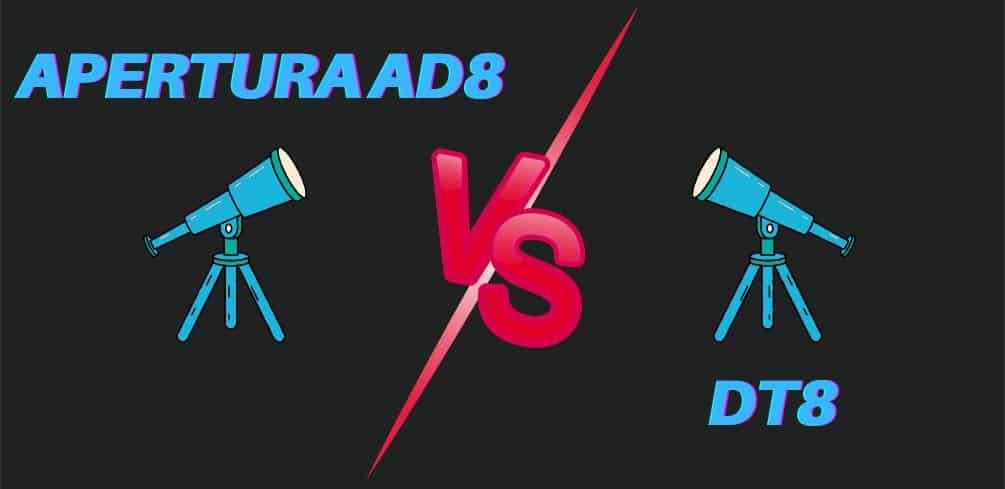
The Apertura AD8 and DT8 have the same optics: an 8-inch (203mm) mirror with a 1200mm focal length, so they show the same views. The difference is the kit. The AD8 adds a dual-speed 2-inch focuser, two eyepieces (30mm 2-inch and 9mm), a right-angle 8x50 finder, a cooling fan, Moon filter and laser collimator. The DT8 comes with one 25mm eyepiece and a straight-through finder.
If you are choosing between these two Dobsonians, the most important fact is that the telescopes themselves see the same. Both use an 8-inch f/6 Newtonian reflector with a 1200mm focal length. Everything that differs is in the focuser, the finder and the box of accessories.
Side by Side
| Apertura AD8 | Apertura DT8 | |
|---|---|---|
| Aperture | 203mm (8 inch) | 203mm (8 inch) |
| Focal length | 1200mm (f/5.9) | 1200mm (f/5.9) |
| Focuser | 2-inch dual-speed Crayford (10:1 fine focus) | 2-inch single-speed Crayford |
| Eyepieces | 30mm 2-inch wide-field (40x) and 9mm 1.25-inch (133x) | 25mm 1.25-inch Plossl (48x) |
| Finder | 8x50 right-angle, correct image | 9x50 straight-through |
| Cooling fan | Yes | No |
| Collimation tool | Laser collimator | None |
| Other | Moon filter, 1.25-inch adapter | 1.25-inch adapter |
Package contents can change between production runs, so check the current listing before you buy.
What the Extras Are Worth
- Dual-speed focuser. The fine-focus knob makes sharp focus easier at high power on planets and double stars, without shaking the tube. For low-power deep-sky viewing you will rarely miss it.
- Two eyepieces. The AD8's 30mm wide-field gives a big low-power view for clusters and the Andromeda Galaxy, and the 9mm gives useful planetary power. With the DT8 you will want to buy a higher-power eyepiece soon; see our guide to eyepieces for planets.
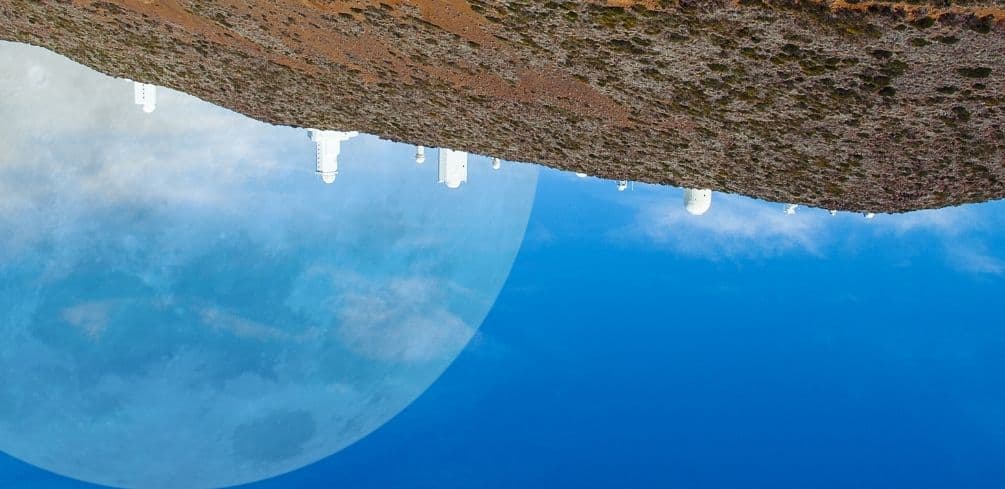
- Right-angle finder. On a Dobsonian, a straight-through finder means crouching under the tube when aiming high. A right-angle, correct-image finder is more comfortable and its view matches a star chart. See why some finders show an upside-down view.
- Cooling fan. An 8-inch mirror takes time to reach outdoor temperature. The fan shortens the wait before planets look sharp.
- Laser collimator. Handy, but check it is itself aligned before trusting it. Many owners prefer a simple collimation cap or Cheshire; see collimation cap vs Cheshire.
What They Show
Because the optics match, so do the views. From a suburban yard, either scope shows the cloud belts and Great Red Spot on Jupiter, Saturn's rings and Cassini Division, lunar craters down to a few kilometers, and bright galaxies and globular clusters. Our guide to what you can see with an 8-inch Dobsonian goes object by object.
The highest useful power is limited by the air rather than the telescope: around 200x to 250x on a good night. A 6mm eyepiece in either scope gives 200x.
Size and Weight
Both tubes are about 4 feet long and both sit on a rocker base, so each moves in two pieces: tube and base. Expect around 50 pounds in total. That fits in most car back seats, but if lifting is a concern, a 6-inch Dobsonian or a tabletop scope may suit you better.
Which Should You Buy?
Choose the AD8 if you want a complete kit that is ready for both planets and deep sky on night one, or if comfortable aiming and fine focus matter to you. Adding a dual-speed focuser, a second eyepiece and a right-angle finder to a DT8 later brings it close to the AD8 in total cost.
Choose the DT8 if you would rather spend the difference on eyepieces of your own choice, mostly observe deep-sky objects at low power, or already own collimation tools and eyepieces.
Either way, neither is suited to long-exposure deep-sky photography: a Dobsonian mount does not track the sky. For a bigger step up, compare the AD8 and AD10, or for a well-known rival, the AD8 and Orion XT8. Still deciding on a type? Try our which telescope quiz.